When the Lagoon Glows Back: A Night Paddler's Guide to New Caledonia's Bioluminescent Waters
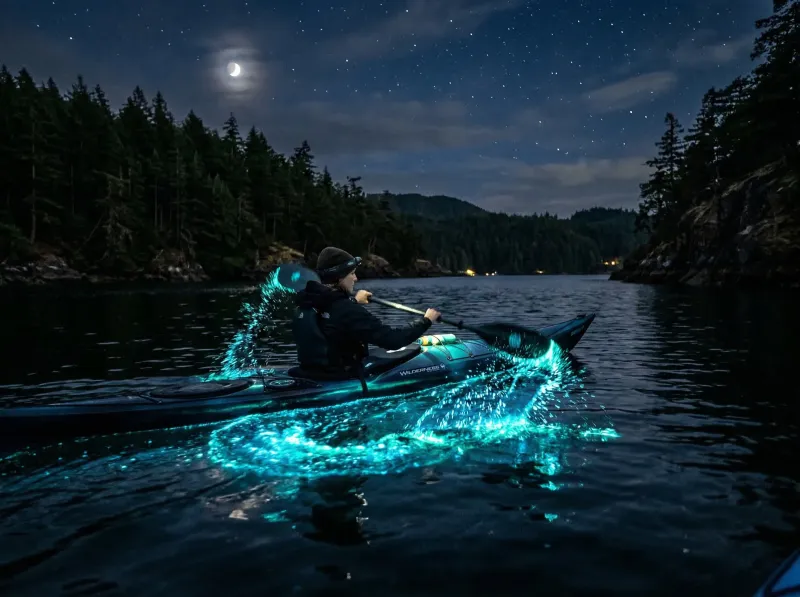
Photo: bioluminescent kayak glowing blue water night ocean, via gondola.travel
Somewhere around minute ten of my first night paddle, I stopped paddling altogether. Every dip of the paddle blade had been leaving a smear of electric blue behind it, and when I finally went still, the water around my kayak lit up like a spilled glow stick. Fish darted away from the hull, leaving neon torpedoes in their wake. Above me, the Milky Way ran edge to edge across the sky. I've chased northern lights in Iceland and firefly swarms in the Smokies, and I'd put this night in the lagoon right up there with both.
If your mental image of New Caledonia stops at turquoise water and white sand, it's time to add a second reel: the same UNESCO-protected lagoon that dazzles by day puts on a completely different show after sunset.
Why the Water Lights Up
The glow comes from bioluminescent plankton — tiny marine organisms that emit light when the water around them gets disturbed. It's a defense mechanism, essentially a startle flash to confuse predators. Waves, boat wakes, and yes, kayak paddles all trigger it.
New Caledonia's lagoon is an ideal stage for this. It's the largest enclosed lagoon on the planet, sheltered by a 1,500-kilometer barrier reef, so its shallow, calm bays let plankton concentrate without being constantly churned up and dispersed. On a good night, the effect isn't a faint shimmer — it's vivid, electric, and close enough to touch.
The science buffs in your group will appreciate this: the light is produced by a chemical reaction involving luciferin, the same compound that makes fireflies work. Same chemistry, radically different delivery system.
What the Experience Actually Looks Like
Most tours run from small launch points along the southern coast near Nouméa and out toward the bays and islets of the deep south. You'll typically meet your guide around dusk, get a quick safety rundown and a lesson in the basic night-paddle stroke (it's easier than it sounds — the lagoon is famously sheltered), then push off as the last daylight fades.
The first fifteen minutes are about settling in. Then the sky finishes its show — and because the southern region sits far from major light pollution, the stars are genuinely staggering. From the US mainland, you simply can't see the Milky Way like this without driving hours into the desert.
Then someone splashes a paddle, and the water answers. Guides know where the plankton concentrate and will steer you to the hot spots. Expect to trail your hand in the water (yes, it's safe), watch bioluminescent halos bloom around swimming fish, and — the universal highlight — see the wake behind your kayak turn into a ribbon of blue fire.
Tours generally run two to three hours and require no paddling experience. If kayaking isn't your thing, some operators offer night swims from anchored boats or beach-based stargazing sessions with telescopes.
Timing Your Trip
A few practical things make or break the experience:
- Moon phase matters most. Bioluminescence is easiest to see on dark nights, so plan around the new moon. A full moon is gorgeous, but it washes out the glow.
- Season: The plankton are present year-round, but the calmer, drier months from roughly April to November tend to deliver the most consistent conditions. Water temperature is pleasant throughout — think mid-70s Fahrenheit in the cooler months.
- Book ahead in high season. Tour groups are small by design, and December through February (the southern summer) sees more demand.
How It Stacks Up Against the Famous Options
American travelers chasing glowing water usually have two names on the list: Mosquito Bay in Puerto Rico — officially the brightest bioluminescent bay on record — and the seasonal glow of Florida's Indian River Lagoon. Both are excellent, and I say that as a fan of both.
But here's the case for New Caledonia: you're not just getting the glow, you're getting it inside the largest marine reserve of its kind on Earth, under skies with essentially zero light pollution, in a lagoon so calm it feels paddling on glass. And since most US travelers are already burning a long-haul flight budget on a South Pacific trip, it slots neatly into a bigger itinerary — reef snorkeling, Isle of Pines beaches, Kanak cultural experiences — rather than being the whole trip.
Plus, and this matters more than people expect: the crowds. Mosquito Bay on a cruise-ship night can feel like a procession. Out here, you might share the water with two other kayaks and a guide who grew up on these shores.
Making a Night of It
Pair your paddle with a late dinner back in Nouméa — the city's bistro scene runs on French hours, so a 9 p.m. reservation is normal, not rebellious. Or head the other direction: several southern beaches and campgrounds stay open after dark, and spreading a towel on warm sand to stargaze after a paddle is about as cheap and as good as travel gets.
Bring a dry bag, wear sandals you don't mind getting wet, and leave the drone at the hotel — most operators prohibit them, both for safety and because the whole point of the night is what you can see with your own eyes.
The lagoon works the day shift for a reason. But if you ask me, the night shift is the one worth clocking in for.